Bringing Math to Life Through Everyday Moments
We are exposed to math concepts from the time we are born, and this continues as we grow. We learn how and when to communicate when we are "all done" and how to ask for more when we are still hungry. Through transitions, we begin to learn the concept of time, and then we continue to learn math concepts through stories, rhymes, and songs. As teachers and caregivers, we also make math part of the children's day by counting toys when cleaning up, counting the days of the week on the calendar, or talking about age when we celebrate birthdays together. Math is everywhere!
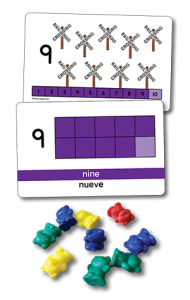
Lillio Learning for Preschool Classrooms includes Counting Cards that facilitate the process of teaching children to count and quantify. On one side, the Counting Cards show shaded squares to teach a certain quantity, and on the other side, they show the same number with colorful and theme-related images. Counting Cards help children learn math vocabulary, practice numeracy skills, and provide a mathematical experience with concrete materials.
Supporting Early Numeracy With Counting Cards
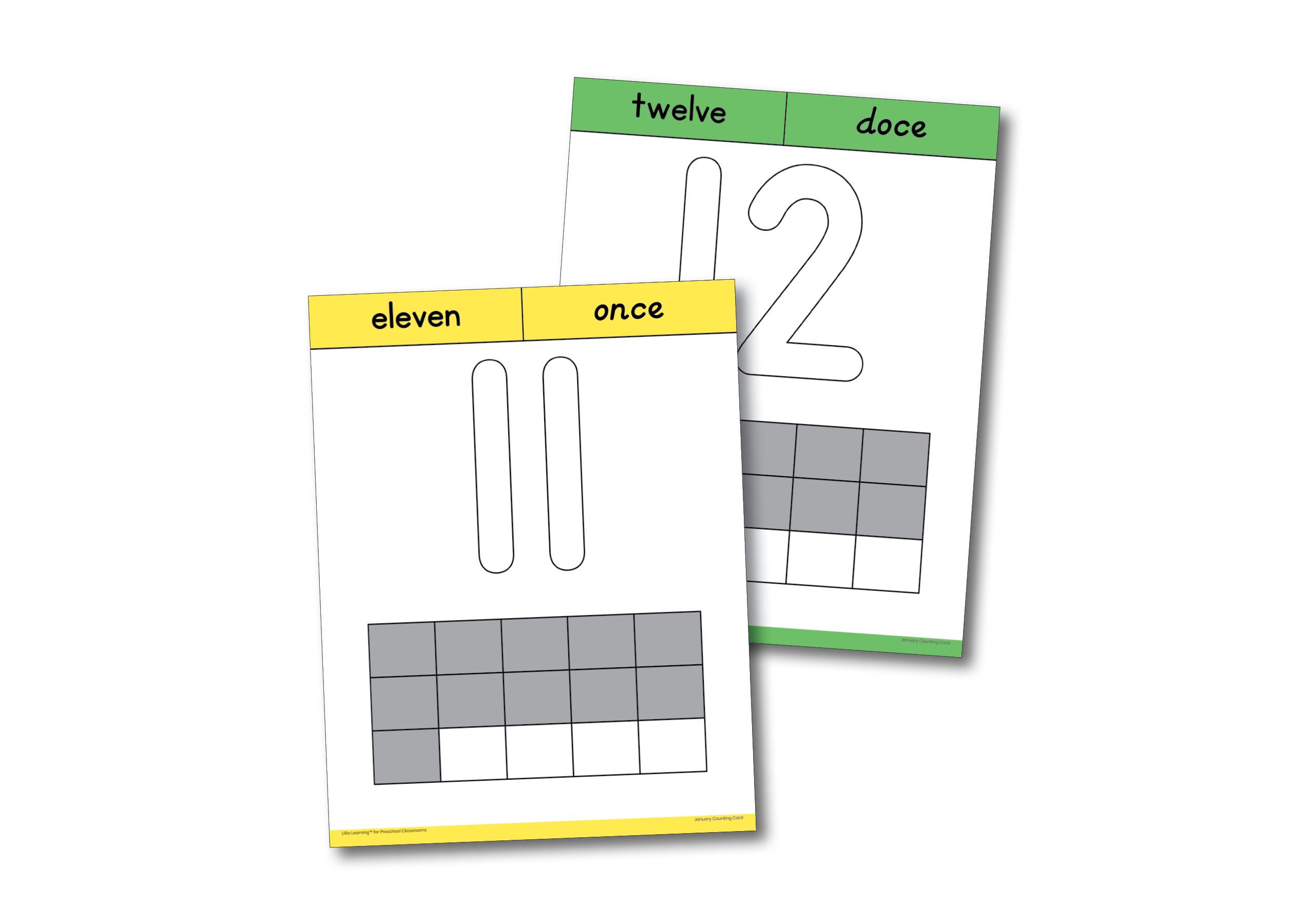
Lillio Learning for Preschool Classrooms includes Counting Cards, intentionally designed to help children build strong early numeracy skills. Each card features shaded squares on
one side to model quantity visually, and colorful, theme-related images on the other to reinforce number recognition through engaging artwork.
These dual-sided visuals allow children to see numbers represented in more than one way, helping them deepen their understanding of quantity, comparison, and counting. As a hands-on math tool, Counting Cards support:
- Math vocabulary development—words like "more," "less," "equal," and "how many"
- Concrete numeracy practice—children can point, touch, and manipulate objects as they count
- Visual-spatial understanding—connecting dots, images, and patterns to numeric symbols
When children can explore numbers in tangible ways, they grow more confident in their ability to problem-solve and make sense of the world around them.
Why Counting Cards Matter in Your Classroom
Early math skills form the foundation for future learning in areas such as operations, measurement, and even early algebraic thinking. Consistent exposure to counting helps children:
- Strengthen working memory
- Build attention and focus
- Develop logical thinking and pattern recognition
- Grow comfortable exploring math independently
Engaging, hands-on tools like Counting Cards not only keep children interested during math activities—they also make mathematical thinking feel accessible and fun.
Cues for Incorporating Counting Cards in Your Routine
1. Offer Counting Cards in your math area.
Pair the cards with loose math counters such as buttons, pom-poms, or theme-related manipulatives. Children can practice matching quantities, sorting, or even creating their own counting games. Independent exploration encourages curiosity and problem-solving.
2. Bring math into play and daily transitions.
Use the numbers on the cards to spark movement or challenges:
- "Let's take five giant steps to the line!"
- "Can you clean up three blocks?"
- "Choose two colors to make your picture."
Simple prompts like these help children connect numbers to real-world actions.
3. Invite children to become math explorers.Ask them to use the Counting Cards to search for items around the classroom. They might look for objects that match the images on the cards or gather a set of items that represents the number shown. This type of scavenger-style counting builds observation skills and makes math active and joyful.